

Cart
0
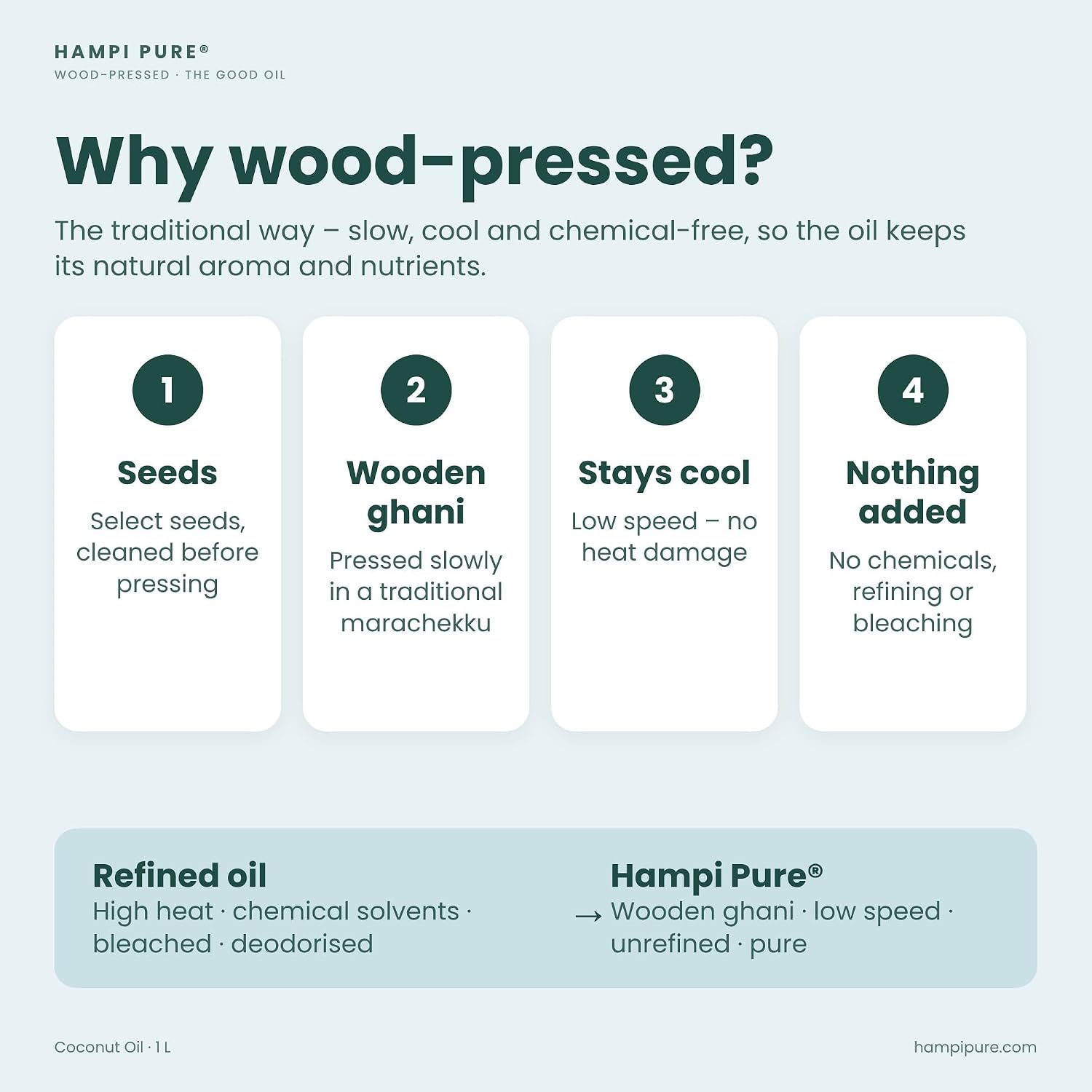
Most of the cooking oil sold in India is refined. The process gives a clear, odourless oil with a long shelf life. But many families are now asking what actually happens to oil before it reaches the shelf.
Step 1: High-heat pressing
Seeds are heated and pressed in large expellers. This gets out most of the oil but leaves some behind in the seed cake.
Step 2: Solvent extraction
To recover the remaining oil, the seed cake is washed with a petroleum-based solvent, usually hexane. Hexane dissolves the oil, and is then evaporated off. Regulations limit how much may remain in the final oil.
Step 3: Degumming and neutralising
The oil is treated to remove gums and free fatty acids, often using acids and alkalis.
Step 4: Bleaching
Bleaching earth or clay removes natural colour pigments, giving the pale, clear look.
Step 5: Deodorising
The oil is heated to very high temperatures under vacuum to remove smell and taste.
What is lost
Along the way, much of the oil’s natural vitamin E, antioxidants and aroma are removed. High heat can also create small amounts of unwanted compounds. The result is a neutral, long-lasting oil – but a very different product from the seed it came from.
The alternative
Wood-pressed oil skips all of these steps. Seeds are pressed slowly in a wooden ghani, the oil is filtered and bottled. No hexane, no bleaching, no deodorising.
How to tell the difference at home
- Wood-pressed oil smells of its seed; refined oil smells of nothing.
- It has natural colour and may have a little sediment.
- It costs a little more, because less oil comes out of the same seeds.


